Bullies and bankers

           I’ll never forget watching my daughter be bullied. We had just walked into a skating rink for a birthday party. We were not two feet in the door when a large, boisterous girl came up to my daughter and said, “Hi, Bucky.”

           My daughter spent the first eight years of her life sucking her thumb. I painted it with vile-tasting liquid. I put band aids on it. All to no avail. When she finally stopped sucking it, the damage was done. So, her teeth protruded.

           My other daughter had perfect teeth, thanks to an orthodontist. She was bullied for questioning traditional Judeo-Christian religion. They told her if she didn’t believe in Jesus, she was going to hell. Her answer: I’ll save you a seat on the bus.

           I can’t remember the reason I was bullied. Maybe there doesn’t need to be a reason. I remember two girls who made my life pretty challenging at Brookfield High School. One of the girls was huge. I’m 5’10” and she towered over me. I can’t remember her name; I don’t care enough to look it up in a yearbook.

           The other girl was smaller, skinnier, with a pinched face. I only saw her smile when she taunted me. I do remember her name. These girls made fun of me for liking school. They made fun of me for wearing a miniskirt to a dance. They promised me a black eye. They were the mean girls. Maybe you know them too.

           They were bullies. While I may not remember their names, I have given them a place of distinction. You’ll find a bully in every book I write. They are my villains, my antagonists.

           Standing right next to them on the shelf of dishonor are bankers. In 2008, the banks were too big to fail. In 2013, we’re told the bankers are too big to jail. I’m not a financial expert. I only know what Stephen Colbert tells me. But I know this: if the federal government investigates you, your misdeeds are huge and sloppy.

           I’m writing about bullies and bankers today because I’m only a few scenes away from finishing the first draft of my middle-grade novel. Toward the end of the book, my amazing main character, Josey, finally stands up to her bully, Andy. I’ve written the scene twice. In the first draft, she just goes crazy and attacks him, much like the movie, “A Christmas Story.” Now, I love this movie. I watch it every December 24th, but I don’t necessarily want to plagiarize it. So, yesterday, I rewrote the scene, but still, Josey used violence to stop Andy’s name calling.

           Josey is an 11-year-old girl; Andy is a 12-year-old boy. If they were both boys, it would probably play out. But when I asked my daughters what they thought, they said that it wasn’t plausible. They said a girl would be more manipulative, more devious in her revenge. Josey doesn’t have a devious bone in her body. She’s not written that way.

           I have a plan. I’m contacting a middle-school counselor in a local school today to ask: How do kids this age confront a bully? When they’ve had enough, when they cannot take the abuse anymore, what do kids do? I want to hear from kids themselves: Write2me@Annettedrake.com.

           Hands and arms inside the cart, please. Tomorrow, we talk about…mice. Eeek!Image

Who are your influences?

When I grow up – and I hope to do so this year – I’m going to write like Deborah Wiles.

Wiles is one of my heroes. I met her at the 2011 Western Washington SCBWI conference in April of 2011. She was the keynote speaker. I’ve been a fan of hers since I listened to an audio recording of her book, “Love, Ruby Lavender.” My twins, 8 at the time, and I were driving from Seattle to Portland. The book was so good that we got to our hotel and sat in the car, still listening. The characters that inhabit Wiles’ books are so rich and vivid that you just don’t want your time with them to end. I believe this is referred to as a book hangover. 

During her speech, Wiles asked the audience, “Who are your influences?” Besides her, here are a few of mine.

Stephen King. His book, “On Writing” is my favorite writing book. My office walls are covered with quotes from this book. My current favorite: “Writing fiction, especially a long work of fiction, can be a difficult, lonely job; it’s like crossing the Atlantic Ocean in a bathtub.”

James Thayer. I have read nearly all of his fiction; I especially liked “Five Past Midnight.” But it’s his book on writing, “The Essential Guide to Writing a Novel,” that is always within arm’s reach. My copy is full of passages I’ve highlighted with whatever pen I could find at the time. His writing is tight. No extra words. I like that.

I’m such a fan of Ray Bradbury that I wanted to name my son after him. (My husband, Chris, said no). Bradbury’s book, “Zen in the Art of Writing: Releasing the Creative Genius within you,” sits on a shelf next to my dictionary and King’s book. Favorite quote: “You must stay drunk on writing so reality cannot destroy you.”

Elizabeth George. Reading her book, “Write Away: One Novelist’s Approach to Fiction and the Writing Life,” taught me to keep a journal of whatever I’m currently writing. George does this to remind herself that whatever difficulties she’s facing with her current work, she’s triumphed over these challenges before. A favorite quote from her:  “Writing is a job like any other. You succeed by virtue of working at it.”

Speaking of which, time to go to work.

Hands and arms inside the cart, please. This next part gets bumpy. Tomorrow, I write about my favorite villains: bullies and bankers. Image

Starting the journey

            I sat across the room from my manager. I knew her look of compassion to be sincere, yet that comforted me little when she said, “I’m terminating you.” My mind raced. How could this happen? I worked for this company for almost four years. I moved my family from Anchorage, Alaska, to eastern Washington in January for this company. Now, with no notice or severance package, I’m fired. Wow.

            Her words did not sink in.

            “Should I plan on working tonight?” I asked.

            “No. Let’s make it a clean break, for you and the staff.”

            I had just worked a 12-hour night shift, and despite the adrenaline racing through my veins, I felt tired. Bone tired. I walked to my car, texting my husband on the way, “Just lost my job. Be home soon.”

            What would I do now? Well, duh. Find another job. I like buying groceries. But in this job market? After being terminated from my last position? And it wasn’t even for anything interesting, like selling the office supplies. Nope. Boring me. I was terminated because my manager thought I didn’t have the skills and knowledge for my current position, despite working in this field for 17 years.

            So, what should I do? Find a job? Absolutely. But I don’t know anybody who can job hunt for 40 hours a week. What am I good at? What can I do better than all the other schmoos out there in Need-A-Job Land? This was the question I asked myself after sleeping that same day, after realizing, no need to get up early. I had nowhere to be that night.

                Well, I write. I write stories for children. In fact, since September, 2011, I’ve been writing a middle-grade novel that my critique group tells me is amazing. I think about the characters all the time. When I think of the darkest moment of the novel and how Josey, my main character, saves the day, I cry. Maybe I should finish my book. I’m willing to bet I’m not the first writer who finds herself unemployed and with enough time to finish their book.

            So, that’s what I’m doing. Every day, when my husband leaves the house at 5:45 a.m. to go to work, I make a pot of coffee and park myself right here. This very spot! I don’t leave this chair until I spew 1,000 words onto the page.

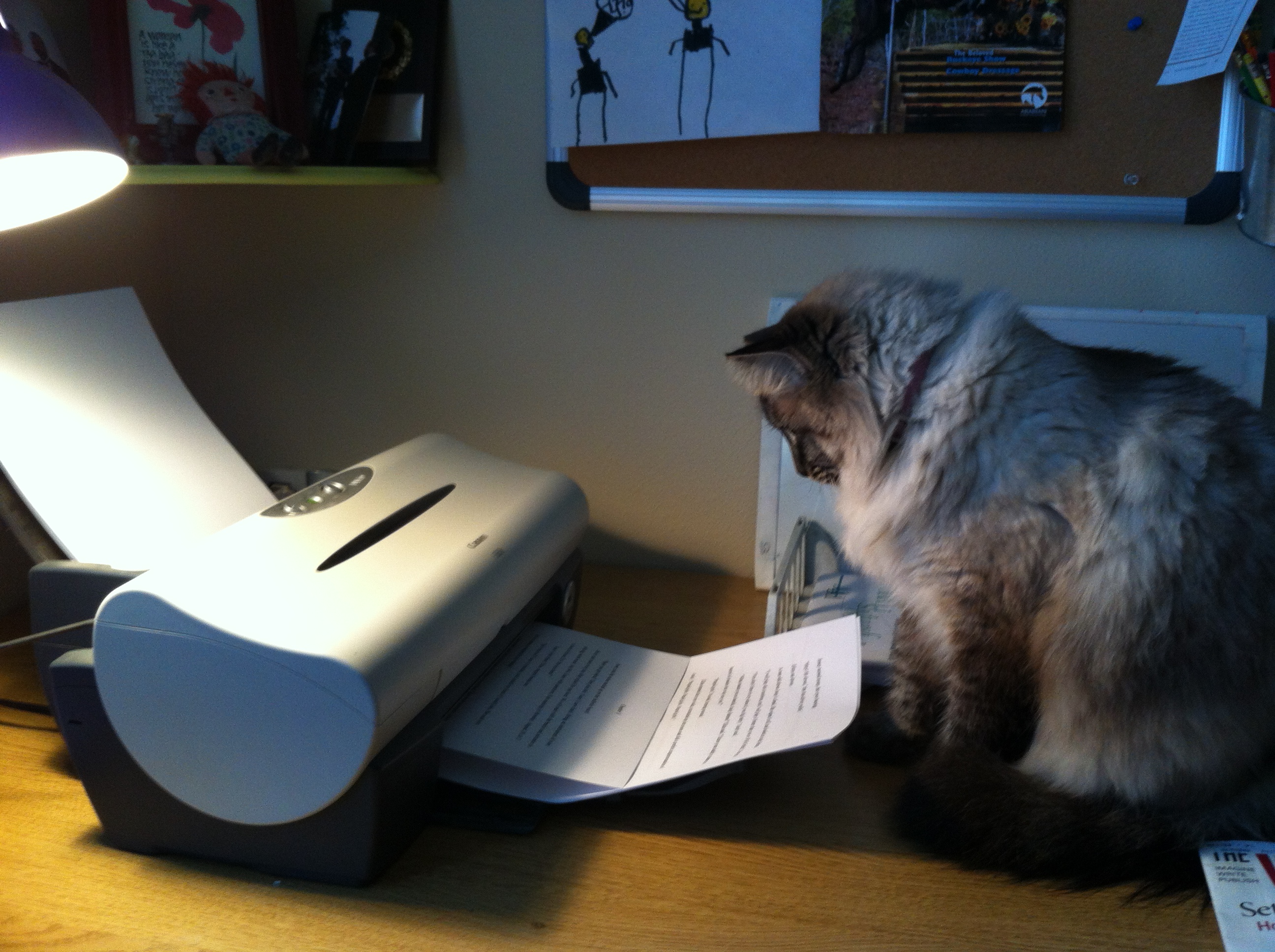
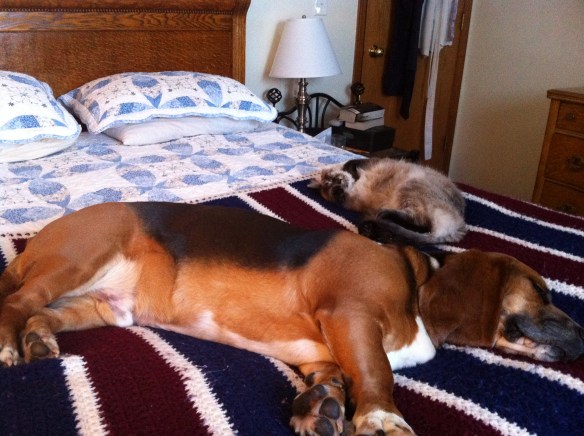
             I’m not alone. I have Ruby, the cat, and Eeyore, the basset hound, to keep me company. Today, I’m starting the blog, and I invite you – anonymous reader – to join me on this wild adventure.

             Hands and arms inside the cart, please. Here we go.