Sylvester, my office on wheels

When I was a kid, the only vacations my family ever took were to the Iowa State Fair. Every August, our dad would fill our pickup truck with enough gear for four kids and two adults, and we’d spend four days camping in Iowa, sleeping in an Army canvas tent. Can you feel the stifling heat I’ve just described?

When I had a family of my own, you might think I’d be a natural at camping. Not so. Some of the worst nights of my life have been spent in tents, either desperately hoping the rain would stop or wishing the drunken campers next to us would take pity on a mother with young children and go to sleep.

My husband, Chris, is a real outdoorsman. One summer, when he was substitute teaching and thus not drawing a paycheck, Chris camped in state parks all summer in a tent. He was perfectly content. He’s that resourceful. I am not.

So when I learned that as part of my husband’s family, I would be expected to camp in a state park in Idaho every last weekend in July, I realized we needed a camper. Enter Sylvester.

Sylvester is a 1968 16-foot Oasis travel trailer. I like to think it’s such an amazing camper because of the year of its birth. Many amazing things were made in 1968. Like me!

We found Sylvester on Craigslist. When we went to see it, we missed the first clue: the owner had stenciled the words “money pit” on the back of it. The small trailer had moss on every surface and one flat tire. We walked inside and unlike the other used trailers we considered buying, I could stand up straight in this one. For me, it was love at first sight. And it had an indoor bathroom. Sweet.

We bought it for the staggering figure of $500. We brought it home, and Chris went to work. He completely sanded down all of the inner wood surfaces and varnished them. He repaired the part of the floor that had been water damaged. He replaced the hot water heater. He reupholstered the dinette seats. A few years later, he made new curtains for our little trailer.

We found a trailer shop in Anchorage, and they replaced the axle and installed a new refrigerator for us. (That’s probably the most expensive refrigerator that Chris and I will ever buy). We had a new awning made for it that matched perfectly the large gold strip painted on the side of our trailer. Remember: 1968.

This little trailer journeyed up and down the Alaskan Highway twice. During a trip in the summer of 2011, it shone most brightly. Chris and I, with Jack, age 4, would drive until we were exhausted, pull over to the side of the road and sleep. In the morning, we’d get up and drive some more. When we reached a town, we’d gas up our car and ask where the local elementary school was. We’d drive there. Jack and I would play on the playground equipment while Chris fixed dinner, usually something gourmet like hamburger helper. 

This year, now that we’re living in eastern Washington, we plan to drive Sylvester to the Midwest for the Obermeier family reunion and then north to Des Moines for the Iowa State Fair. While there, Sylvester will transform from a home on wheels to an office on wheels. I daydream about sitting at the formica dinette table, a hint of wind playing with the curtains, while I compose my next blog. I can’t wait.

Image

Sylvester, the 1968 Oasis travel trailer that we restored, is our home away from home.

Hands and arms inside the cart, please. Next: Storytelling. 

Sometimes, the answer is no

For several years, I have wanted to raise chickens. I daydream about feeding them, holding them and collecting their tasty eggs. I can’t wait for the day when I too can call myself a chicken farmer.

So now that we are no longer living in Alaska and don’t have to worry about bears coming into our yard to eat our chickens, and possibly eating our 5-year-old son, it’s time. I can have my chickens. Well, no. I can’t.

We are renting a house, and according to the homeowner association’s website, the only chickens allowed are the ones on a barbecue grill. Now, that’s where my chickens may eventually end up, but only over their dead bodies. Sorry, bad joke.

For now, the answer is no. I cannot have chickens.

Last week, I submitted my recently completed manuscript, The Celebration House to six publishers. Yes, I’m one of the 3% of people who actually finish writing a book. The soonest I can expect to hear back is 30 days. At the other end of the spectrum, the editors at Harlequin will let me know if they are interested in 12-14 weeks.

It’s likely that since I am an unpublished author and my book is a little unorthodox for a paranormal romance (the heroine dies at the end), that most if not all of these six publishers will tell me no. Thank you, but no.

As a writer, I’ve got to make my peace with rejection. It’s part of the life I want. But I take comfort in knowing that I am not alone. Some pretty amazing writers have been rejected. A lot.

Dr. Seuss’ first manuscript, And to Think that I saw it on Mulberry Street, was rejected 27 times.

One of my favorite books, The Help, by Kathryn Stockett, was rejected 60 times.

Dune, by Frank Herbert was rejected 20 times.

Lord of the Flies, by William Golding, sold 14 million copies and won the Nobel Prize for Literature. Pretty impressive for a book that a rejection letter describes as “an absurd and uninteresting fantasy which was rubbish and dull.”

Animal Farm, by George Orwell: an American publisher told Orwell that “it is impossible to sell animal stories in the USA.”

I know as soon as those rejection emails start rolling in, feelings of discouragement will likely come with them. But that’s okay. I’m prepared. I already have Plan B.

If Harlequin rejects The Celebration House, and I suspect they will, I can submit the manuscript to Carina, Harlequin’s e-publisher.  But only if Harlequin rejects it. There’s also the possibility of self-publishing the book. I just need a winning lottery ticket.

Now, as far as a Plan B for the chickens, who of my neighbors would rat me out to the homeowner’s association if I just, you know, went ahead and got them? The chicks would live inside for the first eight weeks anyway. We plan to move in the summer of 2014. Hmm. Maybe I can make this work.

Hands and arms inside the cart. Next: my office on wheels.

Image


Illustration by Margie B. Segress. Doesn’t she capture perfectly the image of hope with this little character? To see more of her work, go to http://www.ByMargie.com.

Inspiration from a source close to home

The job of every storyteller is to give the main character a burning desire for something or someone. In my novel, Bone Girl, my main character, Josey, wants her mother to come home and love her, to be the parent she was before her mother went to prison. This is Josey’s reason for all that she does.

So, if I have given Josey this burning desire for her mother, Rebecca, how do I take it away? Because eventually Josey will realize what the reader has known since chapter 1: Rebecca cannot be a fit mother. This question puzzled me for a long time. I actually stopped writing this novel because I had no answer. It was only after my Aunt Mary Rose and I started corresponding on a more frequent basis did the idea of a surrogate mother present itself.  

I would give Josey an example of what a loving mother should be. Enter one of my book’s most colorful characters: May Ellen Jones, loosely based on my Aunt Mary Rose.

May Ellen Jones and her two sons, Leighton and Carson, barrel into Josey’s life when they move back to the home where May Ellen grew up. She’s got a little money from her late husband’s military life insurance, and May Ellen uses that to open her own sewing business. May Ellen knows Josey’s parents; they went to high school together. She sees Josey’s dad do all that he can, but Josey needs a mother’s attention. May Ellen provides this and teaches Josey that “love” is a verb.

Please to enjoy chapter 4 of my book, Bone Girl.

            The next Saturday morning, Josey got on her bicycle and pedaled down the dirt road that ran in front of her house. She’d seen an old beat-up station wagon driving back and forth on the dead-end road, and she wanted to see where it had been going. She found it sitting next to an abandoned farmhouse.

            Josey eyed the gray boards of the one-story building. The front porch sagged; its two supporting columns bowed outward. The front step was missing. One of the boards underneath the porch was broken off and when Josey peered down, a pair of bright eyes stared back.

            The front door opened, and a boy about her age walked out, a biscuit in one hand. He looked at her. Josey looked back. He leaned over the porch railing and took a big bite of the biscuit in his hand.

            “Hey,” he said, wiping his hand on his mouth.

            “Hey.”

            “You live around here?” he asked, before taking another big bite out of his biscuit.

            She nodded. “Just up the road,” she said. “I heard somebody moved into the old Jones place.”

            “That’s us,” he said. “We’re the old Joneses. I’m Leighton Jones.”

            “Josey Miller.”

            “Pleased to meet you. We just moved here from Arkansas. My mama lived here when she was a little girl.”

            “Leighton!” a woman called.

            “That’s my mama,” Leighton said.

            The screen door flung open, and a woman marched out onto the front porch, a little boy perched on her hip. She wore a deep purple dress with silver threads woven into the cloth. Her hair, barely contained by a matching scarf, was the most vibrant red color that Josey had ever seen, and the little boy, tucked into her doughy flesh, had the same bright red hair, cut close to his scalp.

            “Leighton, don’t eat up all my biscuits.”

            She turned now to face Josey, surprised she was there.

            “Who’s this?” she asked.

            “I’m Josey Miller, ma’am.”

            “Miller…” she said, pausing to think. “Carl Miller?”

            “Yes, ma’am. That’s my dad.”

            Leighton’s mother laughed, a deep, loud belly laugh. The little boy shook. “I knew Carl Miller when I went to school here. You look like your daddy, dark like him,” she said. “Well, come on in. I’ll make us all some breakfast.”

            She turned and went into the house. Leighton followed her, holding the door open for Josey. She got off her bicycle, and propped the kickstand down. Josey felt nervous about going into a house that looked like it was about to fall down, but she didn’t know how to say no.

            Josey stepped inside. The early morning sunlight streamed in through the living room curtains. Each panel was a mosaic of fabrics, and when the sunlight hit it, the colors glowed like a stain glass window at the Pine Street Baptist Church. Boxes were stacked in corners. Next to them, Josey saw bolts of fabric of every color, one on top of another, near to the ceiling.

She followed Leighton into the kitchen. A cheerful bright red checked tablecloth covered the small round table. The curtains at the kitchen window matched it.

            “Mama sewed that,” Leighton said. “There ain’t nothing she can’t sew.”

            “Sit yourself down,” Mrs. Jones said. “If I can keep Leighton out of the biscuits, we’ll have us a good breakfast.”

            “Mama, it was just one,” he said, before she shushed him.

            She plopped the little boy on a highchair next to Josey and Leighton. He looked at Josey, stole a glance at his mother who had turned away from him, and shoved his finger up his nose.

            “That’s Carson,” Leighton said. “Mama! He’s doing it again.”

            “Carson, get your finger out of your nose or I’ll get the tobacco sauce.”

            The little boy took his finger out of his nose but not before gobbling up the treasure on the tip of it.

            “Leighton, set the table.”

            The smell of frying sausage filled the kitchen. Josey watched as Leighton’s mother drained the grease into an old Folgers coffee can, added milk to the skillet and sprinkled flour to thicken. She seasoned it with salt and pepper. She stirred and stirred, and when she seemed satisfied, she poured the thick sauce into a white glass gravy boat shaped like a tugboat. She placed the gravy and a plate of biscuits on the table. With that, she plopped down next to Carson.

            “Well, help yourself. Don’t let it get cold,” she said.

Josey’s mouth watered. She couldn’t remember the last time she’d eaten a hot breakfast. Usually she just ate cold cereal or toast with peanut butter.

“So, what’s your daddy doing these days?” Mrs. Jones asked.

“He worked at the Hamilton factory in town before it shut down. Now Dad trains horses.”

“I’m glad to hear there’s a living in that,” Mrs. Jones said. “I worked for fabric shops in Fayetteville until Wal-Mart put them out of business one by one. So I went to work for Wal-Mart. I watched as they bought cheaper fabric and charged more for it. Finally, I had enough. I said to myself, May Ellen, what can you offer folks that Wal-Mart can’t? My sewing. I plan on making my living that way. What about your mama, Rebecca? What’s she doing these days?”

Josey choked on her food. This was always a difficult question when people who didn’t know asked about Mama. Josey took a deep drink of cold milk.

“She’s living in Kansas City, ma’am. We don’t see her as often as we’d like.” She’d heard Dad say that to some busybody once.

May Ellen looked at her, nodded, and took a bite of biscuit.

“Carson, you can eat what’s in your nose or what’s on your plate, but you can’t do both,” she said, pulling his finger out of his nose a second time.

The room was quiet as the biscuits and gravy disappeared. Josey accepted a second helping while Leighton ate a third.

“That was real good, ma’am. Thank you.”

“I know it won’t do no good to tell you, but you’re welcome to call me May Ellen.”

“Yes, ma’am. I mean…”

“I understand. I grew up around here too. I know we’re taught to say ‘ma’am’ and ‘sir’ while we’re still in our cribs. You’re welcome for the breakfast.”

May Ellen took their empty plates and plunked them into a basin of hot soapy water. She handed Leighton and Josey each a clean dish towel to dry while she washed. After the kitchen was clean, Josey thanked her for breakfast and left.


Hands and arms inside the cart, please: Next. The answer is no.

Easter with my Aunt Mary Rose

Today is the Wednesday before Easter. Growing up, this was an important day for me because this was the day my mom picked my brother, Paul, and I up from school, and we drove seven hours south to my aunt’s house. There we spent Easter weekend with my Aunt Mary Rose, Uncle Bob, and my three cousins: David, Danny and Billy.

My aunt lived outside of Fayetteville, Arkansas. Uncle Bob raised chickens, lots of chickens, and coon hounds. It’s a different a life than I know now. My cousins and I played basketball or four square or swam in the creek or explored. I remember being outside all of the time. I remember being busy.

My aunt handled her three boys with such aplomb. Nothing fazed her. I think that might have been an occupational skill. She was a registered nurse at the VA.

My aunt has this delicious drawl. She can turn the word “baby” into three syllables. Some of my favorite Aunt Mary Rose sayings: “Never trust a skinny cook,” and “Well, Louise (that’s my mom), I get home sooner because I don’t poke ass along.” (My mother was the world’s slowest driver. No, really. The slowest).  

I was the only girl among all of these boys, and I like to think that I kept up with them. I was proud to run with my cousins. I wanted to do whatever they did. My moment of honor was when my cousin, David, lost a $10 bill. That was big money in 1970-something. I found it. I looked down on the ground and there it was. I was the hero, for all of two minutes, but you take your glory where and when you can.

One year, my cousins and I walked down to a nearby creek and found a huge piece of Styrofoam floating there. We made a raft out of it and spent the entire day playing in this muddy water. Unfortunately, I played barefoot. Holy buckets but my feet hurt.

I’ve kept alive the Easter traditions that my Aunt Mary Rose taught me. My children and I color dozens of eggs on the Saturday before Easter. We also watch “The Ten Commandments” every year. Oh, Moses! Moses! 

Even now, at this time of year, I feel the strongest pull to go home. This must be something akin to what birds feel when they migrate. I feel like I’m missing something, like part of me is lost and can only be found by getting in the car and driving to my aunt’s home. The drive is a little further now: 27 hours or 1,800 miles from my home in eastern Washington to Fayetteville, Arkansas. If I leave by Friday, I should make it in time for Easter dinner.

Hands and arms inside the cart, please. Next: Aunt Mary Rose saves my novel, Bone Girl.


Image


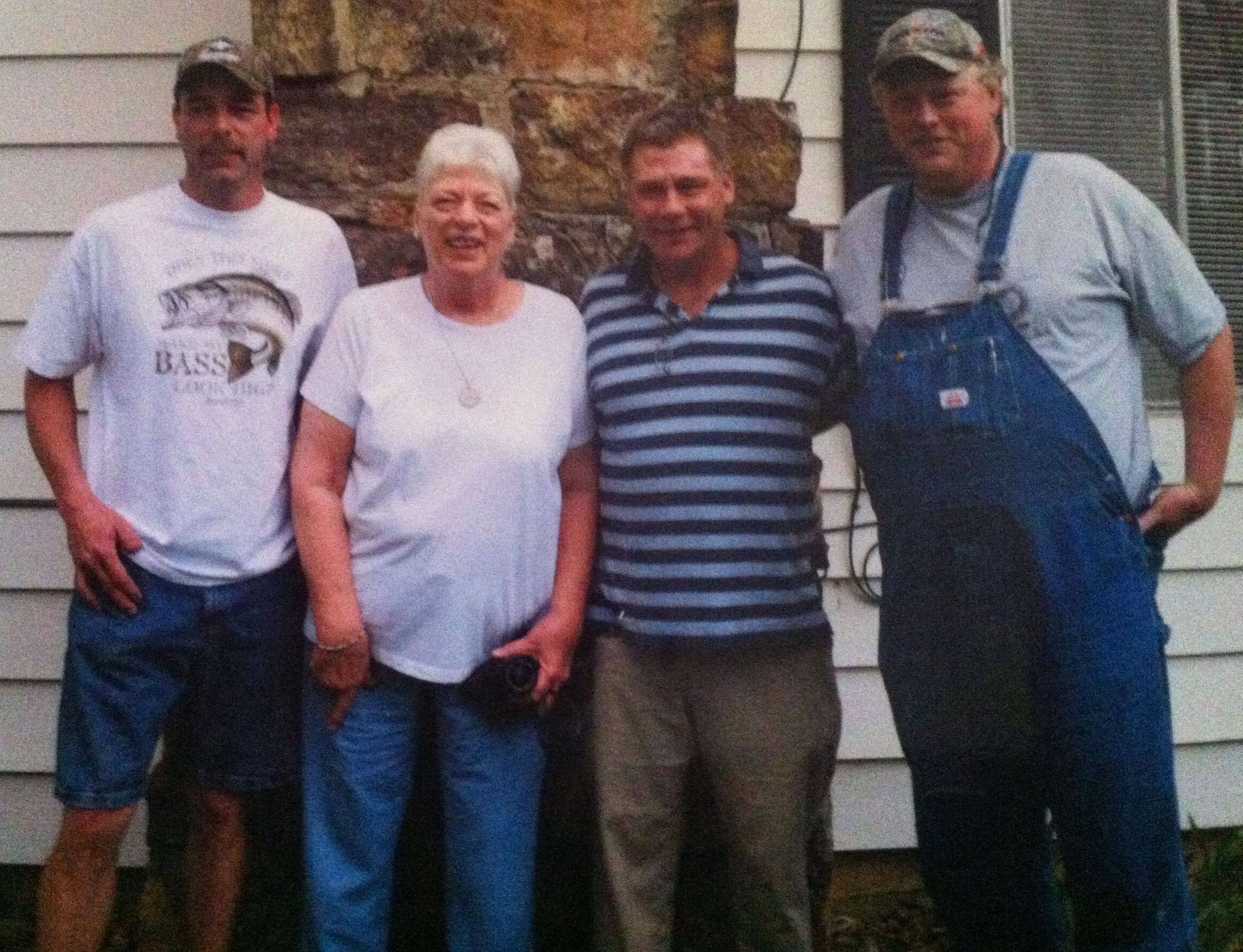
Who are these three old farts with my Aunt Mary Roses? From left, Bill; center, Danny; and on the right, David.

SCORE!

Earlier this week, I visited the offices of SCORE. No, I didn’t know what that was either.

SCORE is the acronym for Service Corps of Retired Executives, an organization started in 1964 to help would-be entrepreneurs (like me) start their businesses. I met with two volunteers to talk about my publishing venture, Baskethound Books.

SCORE works alongside the Small Business Administration to help newbie tycoons start a business. Clients can meet with experienced business people and receive an hour of free counseling. Three of my most important questions were answered: I do need a business license (cost: $15); I should trademark the name of my business but only in Washington (cost: $5) and the best structure for Baskethound Books is sole proprietorship.

I keep stumbling onto these resources that are available for little to no money. For example, SCORE offers classes that cover every aspect of how to start and run a business. The cost is $40 for a four-hour workshop. Cheap. Fits my budget perfectly.

When I made the appointment, I expected two retired business executives, like Statler and Waldorf of the Muppet show. That’s not who I met. I met a young man, whom I’m pretty sure hasn’t yet celebrated his 30th birthday, and an older woman who answered my questions as fast as I asked them. They were terrific.

When I asked if I might qualify for a business loan of say, $2,000, to start Baskethound Books, I got an understanding of just what small potatoes I am. The counselors looked at one another with raised eyebrows, and the older woman told me that SBA loans start at $50,000. No banker would talk to me for less than a cool half million. Okay…

The best advice I received from them was to find knowledgeable people to help me through the maze of taxes and money management. I’ll need an accountant and down the road, I’ll probably need to hire an attorney, someone who specializes in business law. They gave me a list of names for both and encouraged me to interview these professionals before I hire.

SCORE – for the life of your business.


Image

(Above) Waldorf and Statler are Muppets, not retired CEOs. They are owned by Walt Disney Corporation, whose permission I did not seek before using their image in this blog. Please do not sue me.

Why I blog

Last night, on my way home from a local writers meeting, my husband told me that our daughter asked why I wasted my time blogging. Could I really support us by blogging?

The answer is no. I can’t pay any of our bills with this blog. But writing these 500 words or so at least three to four times a week was never intended to do that. I started a blog because I wanted to introduce myself to future readers, to build a platform so that when I did publish a book, I might have a few booklovers who already knew me.

But over the last month, this blog transformed into far more than just a way to introduce myself.

It’s become a writing treadmill. I build storytelling muscle by writing these 500 words or so a couple of times a week. And it’s a source of unexpected affirmation. Caitlin, my daughter’s best friend, told her how good my banana bread looked when she saw a picture of it on this blog. The trainer at an IT class told me she follows my blog. A friend in Willow, Alaska, sends encouraging words. All because of this blog.

Blogging builds new connections and strengthens those already in place. For example, a member of my critique group saw my blog and started one of her own, the occasional meatcleaver. That inspired her dad to start a blog. He read his first entry last night at the writers meeting. It was hilarious!

I stumbled onto other blogs because of my own and from these, I learned things I otherwise wouldn’t know. I learned about AuthorHouse, the scourge of the publishing world, from a blog posting. I also learned about a website for women writers: SheWrites.

Yesterday was a rough day for my little family. We’re feeling the financial squeeze from the loss of my income. My husband is the voice of reason. I’m the voice of hysteria. Mine is not a helpful voice. I said things to him that I wish I could take back. But in all fairness, he said things too, like “I’m just trying to be supportive of you,” and “We’ll get through this.” See? See what I have to put up with?

After our “discussion,” I marched up to my office, slammed the door shut and began revising The Celebration House. As I did, a calm came over me, and I realized, after a few minutes or so, that I felt happy. Genuinely happy. I made good progress. I revised 64 pages. Only 100 more or so to go. Woo hoo!

I know that today, this blog has no monetary value. Nor do my novels. Right now, they’re stored away on the hard drive of this computer (and in that amazing place called DropBox). They have no importance to anyone but me. Not yet. But I hope one day my stories will support my family. And this blog is an important step toward that goal.

Hands and arms inside the cart, please. Next: what I learned from SCORE.

Eeyore, the baskethound

Image

Eeyore, the baskethound

At the veterinarian yesterday, we were told he has gained 12 pounds since we moved to eastern Washington. Twelve! I couldn’t believe it. Per my request, the staff weighed him three times. The last weigh, Eeyore sat down on the scale. I asked them to have their scale professionally calibrated.

A dog’s purpose

Our dog, Eeyore, is a basset hound, or as we say in our family, a baskethound.

As far as I can tell, Eeyore has one mission in life: to love us. That is his purpose. Wherever we are in the house, there is Eeyore. God help me if I sit down on the floor. He’ll plop onto my lap before my butt touches the ground. He loves us, desperately, like a teen-age boy loves the prettiest girl in high school. But not from afar.

I know many dogs have other purposes. I’ve watched dogs pull sleds in Alaska. I’ve seen sheep dogs round up their charges. But I had never seen a true “guard dog” until last week.

Near where I live, a man has chained up a pit bull outside a deserted barn to guard the precious contents inside. I know this because I contacted the local animal shelter to tell them of this dog, which I thought had been abandoned. When I called, the operator told me I was the 10th person to call about the dog. She said that because the man checks on the dog twice a day, he isn’t breaking any law. According to her, the man is afraid if the barn is left unguarded, someone will break in and steal his tools. Thus this guard dog, who spends his days chained up there. No walks. No chasing a ball. I hope the man spends a few minutes petting the dog and playing with him, but whenever I see the man working there, I see neither of those things.

I can’t even get up and walk into another room without Eeyore following me. I think if this hound was chained up outside an abandoned barn, he would go insane and die.

I’ve thought about sneaking the guard dog food, just to make sure he isn’t hungry. I’ve thought about stealing the dog if he would let me close enough to take him. All of these suggestions go over like a lead balloon with my husband.

I usually close these blogs with some resolution or tidy conclusion. But I don’t have one for this blog. Just a conviction that whatever tools are in that old gray barn, they’re not worth the price the dog pays to guard them. 

The IT shop around the corner

When I turned my attention to writing fulltime, I soon realized that I needed a better understanding of technology. I kept stumbling onto software programs and internet offerings that everyone else already knew about. An example: Dropbox.

The leader of the critique group in Alaska attempted to teach me and the other members of the group about Dropbox in 2011. I never really got it. The whole idea seemed foreign to me. I visit an internet website, download this program and read someone else’s writing before the meeting? Weird.

But when with my laptop started doing strange things, I feared that all of my words would simply disappear one day when this computer died, as laptops are wont to do. Per an article in a writing magazine, I downloaded (for free!) Dropbox and safely deposited my precious files in there. So when this laptop does indeed go belly up, my words are safe.

Even this blog that you’re reading has been a stretch for me. My daughter started it, but now it’s up to me to write the posts and publish them. Also, I think posts with pictures garner more attention, so I try to include a photo whenever I can, depending on the subject. But currently, the pictures I post are HUGE and awkward. There’s got to be a better way.

A fellow member of my current critique group told me about Tincan, a (for free!) resource for people re-entering the workplace who need help with new technologies. Yesterday, I attended a beginning blog class and stumbled onto what I hope will be a resource for me.

There were four students in the class, including myself. One of them was a woman who was applying for jobs with nonprofit groups; part of her job responsibilities would be to write a blog. Interesting. Blogging as a job requirement? Another attendee was a tech writer who told me about a group of science fiction writers in town and annually, they host a Spokane version of Comic-Con. How cool is that!

The instructor of this hour-long class offered to meet with me one-on-one and share her expertise in fine-tuning blogs and creating a website. I’m told this can be done via WordPress, the blogging platform I use. She told me that recently, a group she works with sought a bid for a professionally designed webpage. Guess how much? $6,000. Wow.

The “aha” moment of the class for me was when she told me she had actually read my blog! I couldn’t believe it. She said she’d seen a photo I posted of my husband. Was he a tall man with a beard? Beard, yes. Tall? Not so much.

But it was the catch phrase that I end every blog with that caught her eye: Arms and hands inside the cart, please.

Tomorrow, a dog’s purpose. 

Image


Tincan offers free workshops on all kinds of topics, from internet basics to exporting and uploading videos. Their computer lab is located at 1317 W 2nd Avenue in Spokane.