A quick visit to The Celebration House

For nearly a week, I have been typing and editing like a fiend! I am determined to finish a manuscript that I started writing before my son could walk. I think I mentioned it to readers in my last blog. Perhaps you remember? It’s called The Celebration House.

Anyway, 40,800 words later, I see a light at the end of the tunnel. My main character, Carrie, does too. After all, she’s dying. That humor might seem a little dark, but I know Carrie would appreciate it. After all, I wrote her.

I’ve already composed a short list of places I want to send it. Imagine! The darn thing isn’t even done yet, and I’m already shouting “Hot off the press. Get it here!”

One of the publishers I intend to query doesn’t ask for the first three chapters or the complete “polished” manuscript. Instead, they ask for the best chapter. I wanted to share it with my faithful readers, so here it is. A trailer of sorts of The Celebration House. Please to enjoy! (Author’s warning: it’s long, about 1,000 words).


Chapter 13

A few days after Liz Mullins’ visit, Carrie’s cellphone rang. She looked at the caller ID and saw a Seattle area code. She was afraid it would be Melanie and considered not answering it. But to her surprise, Dr. Lionel’s voice greeted her.

“Hello?”

“Carrie? Hi. It’s Dr. Lionel.”

“Hello. How are you?”

“I’m good. But more importantly, how are you? No trouble with your new pacemaker?”

“No. I feel good.”

“I’m glad to hear that, but I’m not really calling to check on you. Do you remember my nurse practitioner, Elizabeth Kozera?”

“Sure. Beth. How is she?”

“Not so good right now. She’s had a pretty bad go of it lately. Any chance she might visit you for a while?”

“Well, sure. She’s welcome to come and stay, but I can’t offer much in the way of amenities.”

“I think a change of scenery is the amenity she needs most. Plus, she can give me firsthand reports on you. Your sister tells me you’re clinging to life. I just hope you didn’t get off your deathbed to take this call.”

Carrie laughed. “To quote one of my favorite Missourians, ‘Rumors of my death have been greatly exaggerated.’”

“So I take that as a yes?”

“Sure. I’ll do whatever I can to help. I’d welcome her company.”

“Great! I’ll have my office manager work out all the travel details, and she’ll call you with Beth’s flight information. Thanks, Carrie. I appreciate it.”

#

She had it all. Or so she thought.

Walking down the aisle, past her friends and co-workers who smiled at her and waved little discreet waves, Beth Kozera thought she was the luckiest woman in the world. And there he stood, her version of Prince Charming: Charles William Mercer, the Fourth. One of his great-great ancestors had been a founding father of Seattle. She lost track of how many streets in the downtown area bore his name.

And now Beth stood next to him. Her father lifted her expensive Italian lace veil and kissed her on the cheek. He stepped away and joined Beth’s mother in the church pew. Beth turned to face Charles. Charlie, to his friends. She was sure he must be as joyful as she felt. But, he didn’t look happy. He looked worried, biting his lower lip and glancing behind them as if looking for someone.

“Charlie?” she whispered. “Is everything okay?”

“Just peachy. I’m fine. Let’s get this done.”

They turned to face the minister, the Rev. Montgomery Todd. He had performed the
wedding ceremony for Charlie’s parents and baptized this young man as a baby. He smiled
at the couple.

“Dearly beloved. We are gathered here today to join this woman and man in holy matrimony…”

“Oh, for the love of God, Charlie. How long are you going to let this little farce play out?”

Everyone turned to look. There, standing at the back of the church in the main aisle was a pregnant young woman with dreadlocks, tattoos and black gauge earrings. Her black tank top fell short of the monumental task of covering her burgeoning belly.

Charlie turned to face her. His jaw dropped. He turned back to Beth.

“I can explain,” he said.

On the groom’s side of the church, a petite brunette dressed in a pristine ivory suit stood up. Her caramel highlights captured the sun’s rays through the stained glass windows. She faced Charlie.

“I’d like to hear this too. You were sleeping with both of us?”

Everyone turned toward this new voice. Beth looked at the woman and realized she knew her, though she couldn’t remember her name. She was the wife of one of Charlie’s law partners.

The church broke out in a bedlam of voices.

“Charlie?” Beth asked, looking up at him. And then she saw. She saw everything right there on Charlie’s face. The answer to “this little farce.”

“Beth, I wanted to tell you for the longest time, but I just…I just couldn’t. Beth, I love Sunshine.”

“What? You love sunshine?”

“Her,” he said, pointing to the woman in the back of the church. “Sunshine. She’s pregnant with my baby. You and me, well, that was about trying to please my parents, to be the Mercer they wanted me to be. I’m real sorry, Beth.”

Beth bowed her head and looked down at the bridal bouquet – the white roses and exotic lilies she and her parents couldn’t really afford. Trying to keep up with the Mercers. How pathetic. She walked down the aisle and straight toward the pregnant woman, ignoring the law partner’s wife. When she reached the expectant mother, with her hand propped on her hip, Beth handed her the bouquet.

“Here! These belong to you.”

Sunshine took them, too surprised to do otherwise.

The crowd was on their feet now, looking first at the groom, then at the pregnant woman and the indignant mistress. Murmurs of “What just happened?” and “Did he just dump her for two other women?” were the last words Beth heard before the church door shut behind her. She exhaled, so grateful for the sound of traffic on the busy downtown Seattle street.

Beth saw the carriage that was to take the couple to their wedding reception. The driver stroked the nose of the black Percheron. Beth stumbled over to the carriage and climbed in. Her beaded Vera Wang dress weighed her down.

“Ma’am?” the driver asked.

“You got any booze?”

Looking down, she saw an expensive bottle of champagne chilling in a silver ice bucket, which was engraved with the couple’s initials. Next to it were two crystal flutes nestled in a blue velvet lined case.

“Perfect. Here, open this,” she said. She handed the bottle to the driver.

“Ma’am, where’s the groom?” he asked, popping the cork.

“He’s gonna be awhile. He’s got some explaining to do,” she said, pouring the champagne into one of the crystal flutes. It bubbled over onto her dress.

“Ah, hell. Who needs a glass?”

She threw it down onto the street. The crystal flute shattered, spooking the huge draft horse. He reared.

“Hey! Be careful,” the driver said. He stroked the horse’s neck, whispering reassuring words in a low voice.

“C’mon. You’re my getaway. Saddle up or whatever it is you do. Let’s get the hell out of here.”

#

She didn’t expect Charlie to leave her at the altar, and she sure didn’t expect the local media to care. But they did. That night, when she returned to her modest condo on Lake Washington, two local news crews were standing outside her building, giving live updates on the “Wedding of the Year,” as the media had taken to calling it.

She was scheduled to be on vacation for two weeks, but the quiet of her apartment closed in on her. She called and told her supervisor she wanted to work. Two days later, when she arrived at the office, a reporter from the Seattle Gazette waited in the lobby, demanding to see her. When she left work, another news crew descended on her, asking if she’d been a willing participant in the hoax or had she too been duped?

She muttered “No comment” and climbed into her car.

The next day at work, Dr. Lionel asked to see her first thing when she came in. She walked into his office and sat down across the desk from him. He hummed to himself while he drew a mustache on the picture of Charlie that graced last month’s copy of Seattle Metropolitan Magazine. The headline read “Seattle’s golden boy takes a bride.”

“Hi, Beth. Having a rough week?”

“I’ve had better,” she said, watching him draw bushy eyebrows and glasses on the glossy
image of her ex-fiancée.

“Our little office staff isn’t used to all this media attention. My guess is you’re not used to it either.”

“Am I in trouble, Howard?”

“No. Not with me. But one of our former patients, Carrie Hansen, is in trouble. Have you ever been to Missouri?”

Hands and arms inside the cart, please. Next, free IT help just around the corner.
Just finish the book!

For years, this quote hung above my desk:

95% of people talk about writing a book.

30% of people start writing a book.

3% finish it.

It’s confession time: I have never completed a full-length novel. I’ve written several picture books and one chapter book. Okay. That’s nice. Most picture-book manuscripts are less than 1,000 words; my chapter book numbers about 10,000 words. Novels, almost by definition, are usually more than 50,000.

You may remember my references to Bone Girl, a children’s novel I’m writing. Is it finished? Nope. I have just one scene left to write, one pivotal day I must create, before I can type those two beautiful words: The End.

But, alas, I don’t know enough about equestrian endurance riding to write that scene. I’ve stumbled upon a great book, Endurance Riding 101 by Aarene Storms, and because the two local library systems would not (Spokane County Library) or could not (Spokane Public Library) get this book for me, I downloaded the Kindle app onto my laptop and bought the book. I felt really proud of myself for doing this. After reading Endurance 101, I made a mad dash to this computer and rewrote the first draft.

But I need to see an endurance ride before I can accurately describe it. So, I volunteered to help with a ride in early April. I hope by doing so, I can give plausibility to my final scenes and finish the draft.   

In the meantime, since I’ve gone about as far as I can go with Bone Girl, I’m turning my attentions to a supernatural romance, The Celebration House, that I started writing in 2008. Yesterday, I wrote my one-sentence pitch with which I will woo agents. (Say that fast three times). Here it is:

The Celebration House is the story of a terminally ill woman who meets the man of her dreams when she purchases and restores an antebellum mansion to be used as a venue for life’s celebrations.

What’s really fun about revisiting this manuscript is using cuss words and writing scenes of, shall we say, a more adult nature. Hey, that’s not easy when one of the characters has been dead for 150 years. I’m aiming for ghostly seduction. Okay, truthfully, I just want to finish the book.

Hands and arms inside the cart, please. Next: I audition for a play. Yikes!  

The ideal reader

Who is my ideal reader?

You! Of course. Thank you for reading this blog. I’m amazed that people, friends, relatives, even strangers, take the time to read these words. Thank you!

But second to that, who am I writing for?

I’ve come to realize that the answer to that question depends on which manuscript I’m working on. The project I’ve spent the most time on lately, Bone Girl, is written for a 12-year-old girl, probably in band, who just feels like she’ll never make the cool-kid list. She might be a little bit clumsy, perhaps a little awkward, but she’s got a heart of gold. She loves her parents, enjoys playing in the band, and hopes to be a horse vet when she grows up. With my mind’s eye, I see her sitting on her front porch swing, reading my book. I really love that image.

For my most recent project, The Celebration House, the ideal reader is someone else. This novel is targeted toward a woman much like a former patient of mine. Let’s call her Mary.

Mary was admitted to the hospital where I worked because of an accidental overdose. At the time, I remember thinking, how on earth can someone accidentally overdose? Now that my fifth decade is just over the horizon, I get it. Memory is a great thing; I sure miss mine.

Anyway, what was I talking about? Oh, yeah. Now I remember.

When I wheeled Mary out of the hospital where I was working, our small talk turned to books. Mary loved romance novels. Now, this genre doesn’t always get the respect that I feel it deserves. It’s looked down upon, much like band geeks. I asked her why she liked romance novels. She said reading them let her be somebody she could never be and let her do things she would never do. She had my heart.

So, Mary, as I type furiously to finish The Celebration House, I think of you. Well, after all, you’re my ideal reader.

Along with everyone else who just finished reading this sentence.

Hands and arms inside the cart, please. Next: Finish the book!

Room with a view

According to Virginia Woolf, “A woman must have money and a room of her own if she is to write fiction.” I agree, and now, I have a room. Someday, the money will follow.

My family lives in a four-bedroom house, and with my oldest daughter in college and a teen-age son living with his father in the Midwest, I have a room all to myself. It feels like such luxury.

Before moving here, we lived in a three-bedroom house and my “office” was in a corner of the bedroom. Here, I stuffed a desk, computer, printer, bookshelves. Well, you get the idea.

I didn’t know it then, but I was in good company. Stephen King wrote Carrie on a child’s desk in the laundry closet. Ray Bradbury wrote Fahrenheit 451 at his local library, plunking down 10 cents for 30 minutes of time on a rental typewriter.

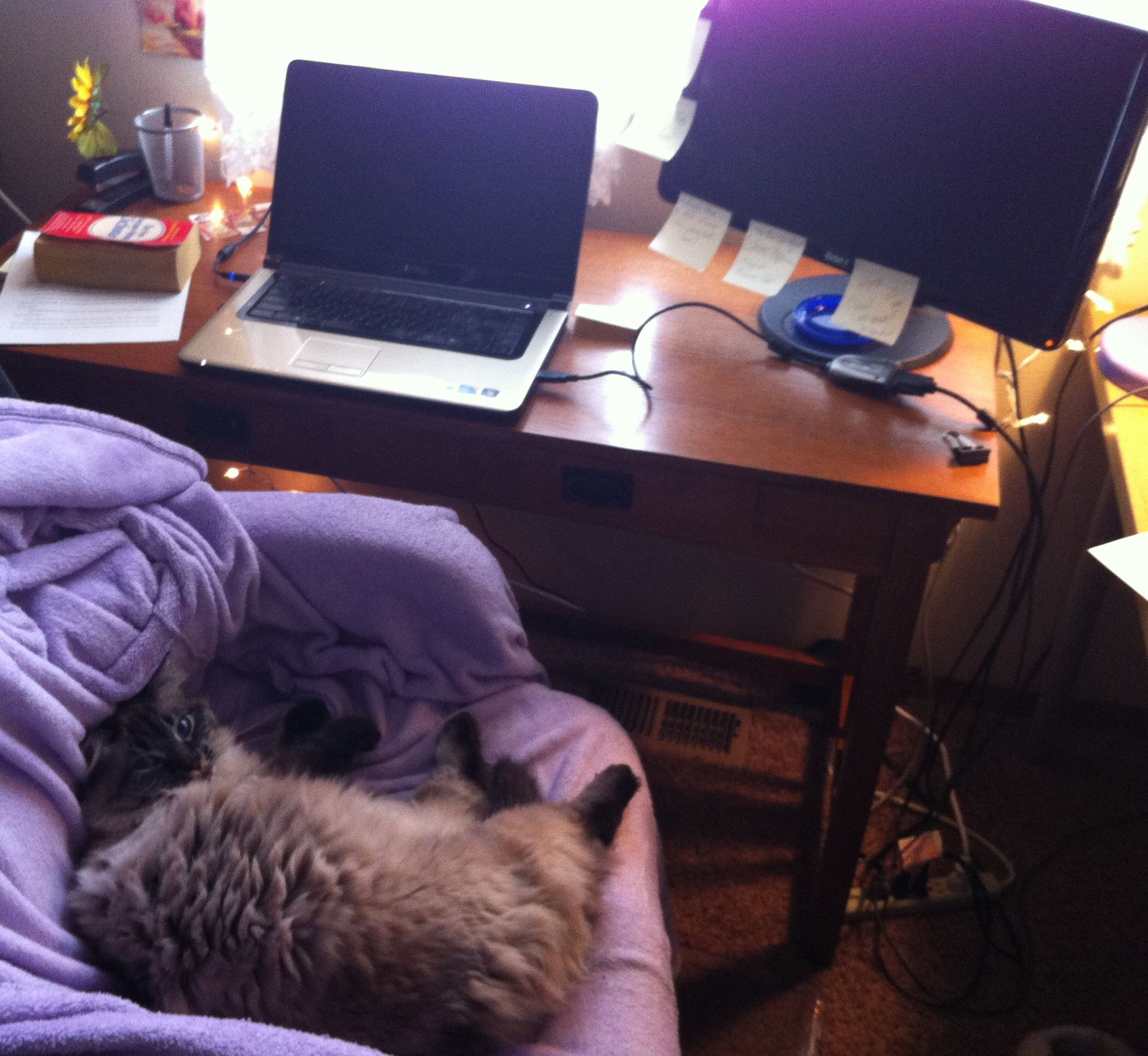
My room is full of my favorite things: my books, pictures of my children and their artwork, and exotic angels suspended from the ceiling. The “Happy Light” sits next to my desk. A lack of light worsens my moods, particularly the dark ones. I strung a set of white Christmas lights around the window. They are meant to be playful, a reminder that I’m suppose to be having fun when I write.

Around me are cues to what I’m currently working on. I have cut-out photographs of BF Amigo, a black Arabian gelding, from the cover of Modern Arabian Horse. This is how I envision Chief. Yellow Post-it notes surround my monitor with names of songs that elicit the perfect emotion for whatever scene I’m writing. Sometimes, the songs birth the scene. Mark O’Connor’s song “Emily’s Reel” prompted the scene in which my main character, Josey, plays with Chief. I’ve often wondered if readers would like a CD with the songs I listened to as I wrote a particular book. I’m tempted to put a list of the songs at the back of the book, a musical appendix of sorts.

Of course, the office doesn’t really belong to just me. In a futile effort to make more room in my son’s closet for all of his toys, I moved his bookshelf and all of his books into my office. Now, he calls this room “the library.”

I can’t keep the cat out. When I leave the house and am convinced she’s on the right side of the door, I look up and Ruby is in the window, waving good-bye to me. Darn cat.

My son, Benjamin, and my oldest daughter will visit over the Easter holiday. We can’t wait! My youngest son, Jack, counts the days. Then, the fourth bedroom will revert to its true purpose, and Ben will sleep here. My husband and I will move my desk to the corner of our bedroom. But perhaps that’s as it should be. As King says, “put your desk in the corner, and every time you sit down there to write, remind yourself why it isn’t in the middle of the room. Life isn’t a support-system for art. It’s the other way around.”

Hands and arms inside the cart, please. Next: who is my ideal reader?Image

Ruby keeps my chair warm for me. She’s thoughtful in that way.

Is that a banana in your pants or a plot point?

What do plot points and bananas have in common? Honestly, not much. Except sometimes, it’s best to wait for both to ripen.

Feeling ambitious and still enjoying the high from this morning’s four cups of coffee, I decided to make banana bread with three extremely ripe bananas I’ve had far too long. I’ve been awake since before 4 a.m., working away on the last few scenes of my book. As I worked, it occurred to me that Chief, the stallion who plays a pivotal role in the novel’s dark moment, has a history of being impossible to trailer. That’s chapter 2. So now, in chapter 19, how am I going to get this four-legged fury into a trailer? Hmmm…

I wrote the scene where the villain, Mr. McInerny, tells Josey’s dad, Carl, that he wants Chief to compete in endurance rides so that he can sell him for big money. Okay. Plausible. Chief is an Arabian, the breed used by serious endurance competitors. Chief has great bloodlines. Chief is sound. But, in Chapter 2, he all but destroys a horse trailer. Gotta fix that.

So, I changed Chief’s training from arena work to long rides, five to 10 miles, a day. (Shout-out to Edith Poole: thanks for giving me a quick down and dirty on endurance rides). After one such training ride, Carl parks the horse trailer inside the arena while Josey walks Chief to cool him down. Carl pours grain in a feeding bin in the trailer and leaves the door open. Chief is leery of the trailer. Like my son and the bathtub, he’s not going anywhere near it willingly. So, Josey plays her trombone to coax the horse in. It works. Chief clomps in after her. The scene was fun to write; I hope my readers enjoy reading it. And I move one step closer to typing “the end.” Delicious! Kinda like the peanut-and-chocolate chip banana bread I made this morning. Here’s the recipe. Enjoy!

Banana Bread
1 1/4 cups sugar
1/2 cup butter, softened
2 eggs
3 mashed ripe bananas
1/2 cup buttermilk
1 teaspoon vanilla
2 1/2 cups all-purpose flour
1 teaspoon baking soda
1 teaspoon salt
1/2 cup chocolate chips (more won’t hurt!)
1/2 cup chopped peanuts

Place oven rack in lowest position. Heat oven to 350 degrees. Grease bottoms only of 3 disposable, aluminum loaf pans. Mix sugar and butter in large bowl. Stir in eggs until well blended. Add bananas, buttermilk and vanilla. Beat until smooth. Stir in remaining ingredients. Allow your 5-year-old to add the nuts and chocolate chips, being sure he doesn’t eat all of the chocolate chips instead of adding them. Also, please be sure he washes his hands before he helps. You know where those hands have been!

Bake for one hour. Take out of the pan. Enjoy!

(Stolen from Betty Crocker’s 40th anniversary edition cookbook)

Image


Hands and arms inside the cart, please. Next. BABY CHICKS!
(Yes, I meant to put those two last words in all caps. I’m so excited!)

Self publish? What the heck!

When I told my oldest daughter that I was writing a book, she said, “That’s great, Mom. You should self publish.”

I was deeply offended by the suggestion. Self publish? Only writers who can’t get a traditional publisher to buy their work self publish. And this may have been true five years ago. Today? Not so much.

Today, The Writer is full of articles about writers who have sold their work to a traditional publisher, but then choose to publish their novels themselves. Writers like L.J. Sellers. She used a retirement account to self publish two of her novels, The Baby Thief and The Suicide Effect in August of 2010. By the end of that year, she had sold more than 10,000 copies of her novels. In May of 2012, she signed an 11-book deal with Amazon Publishing.

David L. Robbins has written 10 novels, two screen plays and his third novel, Scorched Earth, was adapted for the stage. He is a prolific writer who chose to leave the traditional publishing house and publish The Devil’s Water with Amazon’s Thomas & Mercer Imprint.

I think Joe Konrath should be crowned the king of self publishing. According to his blog, he has sold more than 6,000 ebooks and had over 1300 borrows on Kindle since March 1. Even he is amazed with those numbers. In his own words, “While I love bookstores and the traditional publishing world, I’ve discovered that I can have greater control over my own work, and make more money, by releasing my ebooks and print books on my own. This also means I can write more novels and stories per year…”

Could there be a better reason to self publish than that?

Man! My kid is smart.

Image

Hot Cross Buns

I met Sarah Porter and Judy Rogers at the February meeting of the Inland Northwest Writers Guild. Last October, these two friends self published their novel Hot Cross Buns. They came to the meeting to share their experiences.

The book took about six years (yes, years) for them to write because they both work full-time and have families. In short, they have lives. Once they felt the book was complete, they queried between 60 to 80 agents and heard either no or nothing. They attended a writing conference in San Francisco, where they heard an experienced editor say, “Agents are a dying breed.” He said with the ease of self publishing and ebooks, authors now can represent themselves.

Judy and Sarah elected to do just that. They started their own company, Penned Press. They hired a professional editor to review the text and a graphics artist to create the cover. Their book, which they own, is available on Kindle or print on demand. They also bought 10 ISBNs, the thumbprint for a book. They used one ISBN for the Kindle copy, one for the paperback version and down the road, they will use another ISBN for the audio recording. Plus, both women agreed that they have more books to write.

The two authors said they have sold about 525 books and have only promoted the book locally. But they are developing a brand name, a following, and that may be the most important part. Only seven percent of all new writers sell more than 1,000 copies of the book. Seven percent! So in these cash-strapped days, publishers won’t invest money in publicity for a new writer. Publishers want authors who are already a brand name, who bring with them a following.

Now, these ladies aren’t quitting their day jobs, and they were courageous enough to answer delicate questions about that most taboo of topics: money. Their book was put together on a shoe string budget, with an initial expense of about $1,000. They priced the novel below $10, so for every Kindle version they sell, their profit is $3.99. For each actual book, they make less than $2. They encouraged us to price our books higher, at least $12.

I think the litmus test of their success was addressed by a particularly astute and intelligent audience member (me!) who asked them if they had it to do it all again, what would they do different? Their answer: nothing.

Hot Cross Buns. Buy it!

Note: when I tried to buy a copy, Auntie’s Bookstore was sold out. Yippee! You go, Sarah and Judy.

Hands and arms inside the cart, please. Next: Self publishing. It’s no longer the red-haired stepchild of the book business.

Why I love children’s books

I grew up in Brookfield, Missouri, a small town of about 5,000 people in the northeast corner of the state. There are a lot of great things about growing up in this community. It’s quiet. It’s safe. An ambulance siren shrieking through the neighborhood is an event.

But there are a few downsides too. One of them is that there’s not a lot to do. I spent my childhood in the days before the internet and VCRs, when the television only had 13 channels, all of which disappeared during bad weather.

So, I turned to books. The local librarian, Mrs. Burns, and I knew each other by name. The only award I received during my school years is for reading the most books in the fifth grade. I’m still proud of that. I read everything I could, including the Encyclopedia Britannica. I liked non-fiction but a good tale that I could escape into? Sign me up!

The thing that I loved then and still do is the lack of pretention in children’s books. You’re not likely to find a 60-word sentence describing a sunset. Nope. Nor are there any of the horrors that are so often captured in the daily newspapers. Usually.

As a mom, I shared my love of reading with my children. When a long road trip loomed, we checked out armfuls of books on tape. I read to them at each and every bedtime. When my kids were old enough, sometimes they would read to me. That didn’t always work out well, though. Often, I’d fall asleep.

In children’s fiction, and I propose in all great fiction, it’s all about the story. The three most important words: what happens next.

Arms and hands inside the cart. Next: Hot Cross Buns: A First Novel by Judy Rogers and Sarah Porter. (Note: I did not say Hot Crossed Buns. That’s a porn site)Image

On the back of this photo, scrawled in my mother’s handwriting: Annette Drake, 7 years, December, 1975.