Cause you got to have friends…

As a new writer, I spend my time rereading my favorite middle-grade novels and dissecting them to see what makes them tick. I just finished doing so with the first Harry Potter novel, Harry Potter and the Sorcerer’s Stone.

I read this to my children years ago. In fact, I’m ashamed to admit, I used the book as a motivator to my oldest daughter to complete household chores. I’d say, if you do this task, I’ll read an extra 10 minutes of Harry Potter tonight. It usually worked.

What I found in this delightful book is how important friendships are to the main character. For this book, the friendship is between Harry, Ron and Hermione, though Hermione doesn’t join in until halfway in the book.

J.K. Rowling uses all three characters to tell her story, though the primary point of view is always Harry. I’m trying to do the same. My story is told almost exclusively through the eyes of my main character, Josey. At her side are her two friends: Eliza and Leighton. Eliza and she have been friends since kindergarten while Leighton is new to Josey’s community. Their friendship starts when Leighton’s mother, May Ellen, moves back to her hometown, Bennett Springs, to start a small business. May Ellen is based on my Aunt Mary Rose.

A few weeks ago, I made a list of seven scenes I still needed to write before I could call this book finished. I’ve crossed off all but two of them. But now I’ve realized that I must develop Josey’s friendships more before I can call this book done. Like Harry Potter, Josey needs her friends. I’ve given her too many problems not to allow her friends. So even though the book isn’t finished, the revisions have already begun.

James Thayer, in his book The Essential Guide to Writing a Novel, tells us that the main character’s sidekick has several important jobs to do. He lists six tasks, but I’ll comment on what I feel is the most important one: entertain the reader. Friendships make for good reading, I might suggest, because they elicit the warm feelings the reader has for his own friends. Thayer uses the example of Frodo Baggins and Sam Gamgee in “The Lord of the Rings.” I don’t think there is a better example.

A final note on Josey’s friends. I have written separate scenes in which Eliza, Leighton and a third classmate, Ricky Salinas, stand up to the boy that bullies Josey. Why, then, can Josey not do this for herself? Hmmm…

Hands and arms inside the cart, please. Next: why I love children’s books. 
Horse talk

Horses feature predominantly in the book I am writing.

My main character, Josey Miller, grew up with horses. Josey is an 11-year-old girl who lives with her father, Carl, on their farm in southern Missouri. Josey has always had an Arab mare, Ruby. She doesn’t know life without her. Toward the end of the book, Ruby is taken from Josey, so she is left with Chief.

Chief is an Arab stallion that their banker, Mr. McInerny, brings to Carl to train. Chief is chaos on four hooves. On paper, his bloodlines look great. The problem is, as my mother-in-law says, you can’t ride paper.

I’m a novice when it comes to horse training, so I didn’t know if this was plausible. Could a horse that is dangerously out of control with one trainer be rehabilitated by another?

I had the privilege of meeting a husband and wife team who compete in equestrian endurance rides on the international level. They are the real deal. He has published a book on this sport. How I got so lucky to meet them and see their horses, I’ll never know. I think it’s indicative of horse people that they are willing to share their time and expertise.

Sitting in their kitchen, they told me that yes, it is plausible that Carl Miller could retrain Chief. They have been given horses that were thought to be beyond rehabilitation and turned those horses around. Changing feed alone could affect a horse’s behavior. It is plausible. The reverse is true too. They have worked with horses that are not capable of rehabilitation. In that case, the horse is put down.

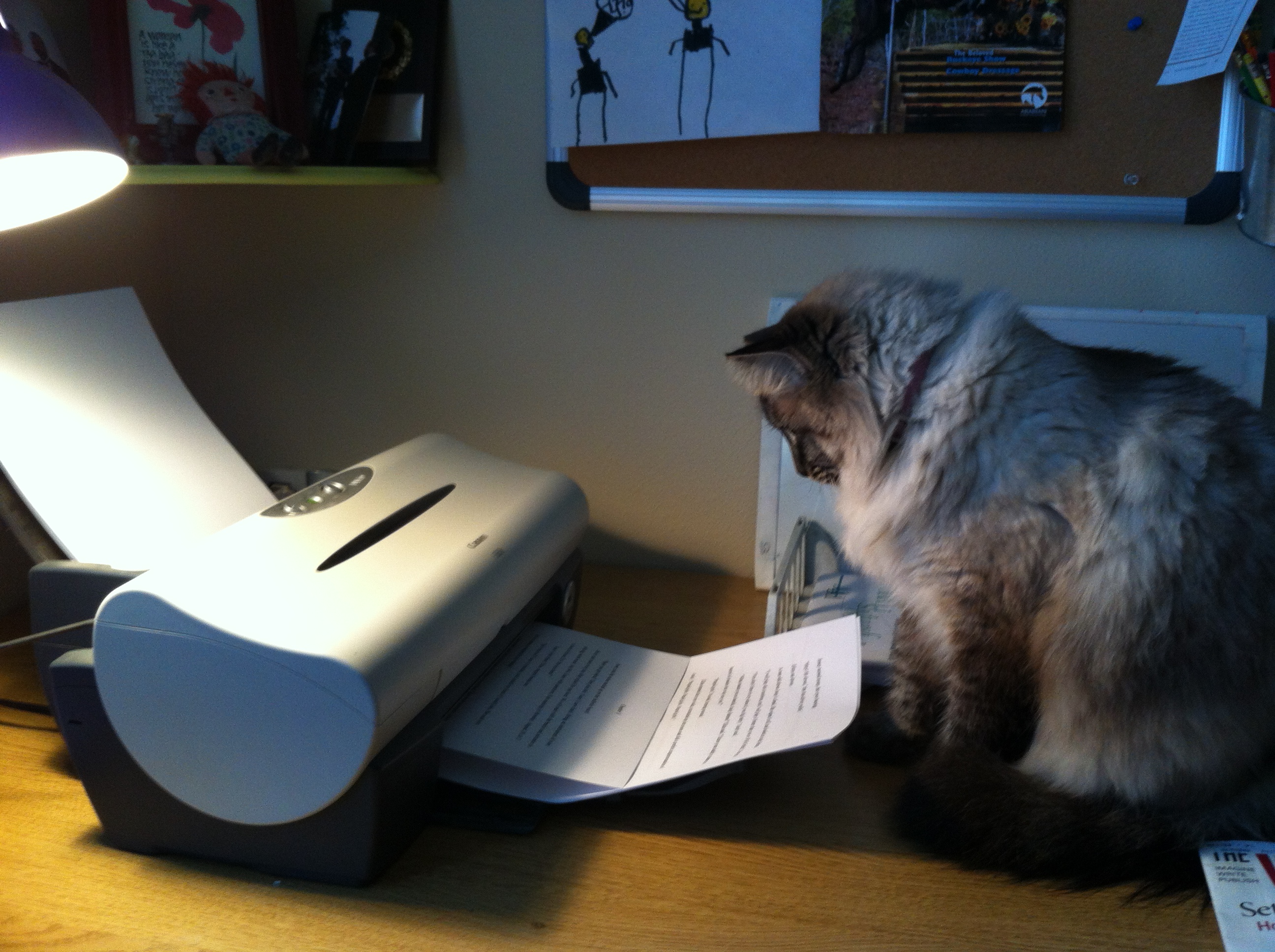
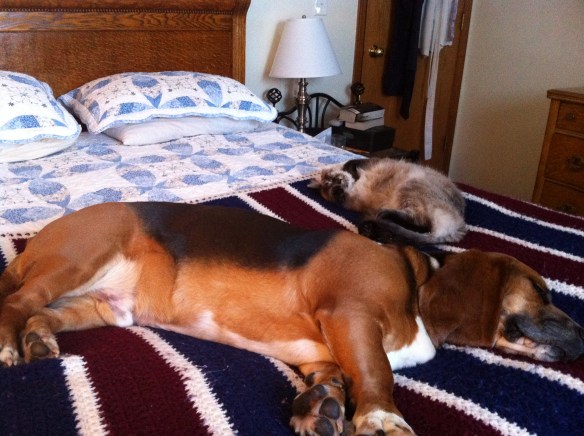
Readers may wonder where I got the name for these pivotal characters. If you’ve been reading this blog, you’ve met Ruby. She’s my cat. As for the name Chief? When I was a young girl, my grandparents owned a pair of American Saddlebreds. The gelding, Chief, was huge. I feared him and rightly so. My grandmother, Dorothy Drake, worked with horses her entire life. She was injured while riding Chief, and spent a few days in the hospital. My memory may be faulty, but it seems like her passion for horses, including Chief, cooled after that.

Hands and arms inside the cart, please. Next: meet Josey’s friends.

Let’s talk horses

For some people, horses are mysterious and magical creatures. For others, they are an ingredient. I live in the first camp.

I met my first horse, Apache Miss, when I was about 10 years old. My grandfather, Carl Drake, bought her for me to learn to ride. Every day after school, he would drive to our house in his old pick-up truck, grab me and off we would go to spend time with Apache Miss. He taught me to saddle her and ride her at a walk and a trot. We never made it to the canter.

On the last day of school, when my brothers and I rode our bicycles to our grandparents’ house to show off our final grades, we found my grandfather lying in his driveway. We called our mother, and she rushed over. She told me he said, “My head…My head.” To the best of my knowledge, those were his last words. And that was the end of our riding lessons. He suffered a massive stroke and died a few weeks later.

My father gave Apache Miss to me for my 11th birthday, but my dad had no interest in horses. He’s not in the ingredient camp, but horses are neither mysterious nor magical to him. My mother was afraid of horses, but to her credit, she found a young woman who gave me riding lessons. I sold Apache Miss when I was in high school. Letter jackets, a drivers license and the possibility of a boyfriend were way more interesting than horses.

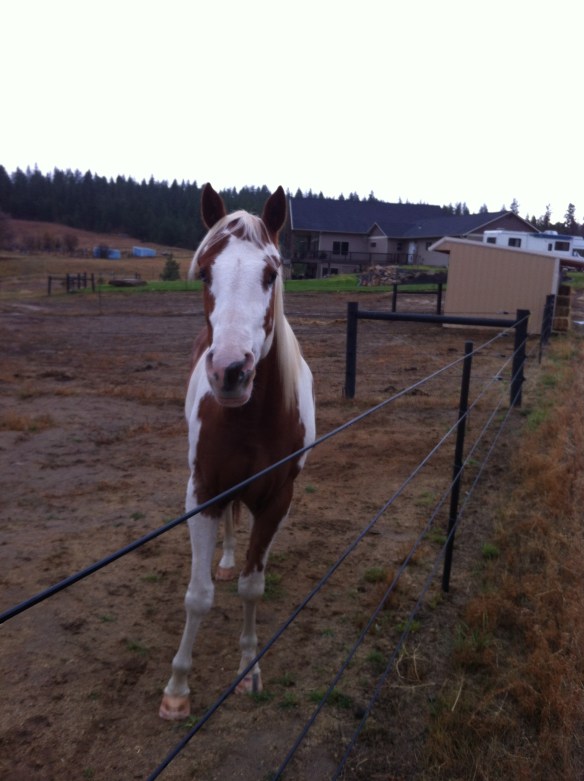
During the winter of 2011, I made the mistake of browsing Craigslist. For sale was a registered paint mare, in desperate need of a good home, for the grand sum of $100. If not bought, she would be shot.

That was a dark winter for me, and I remember thinking that owning a horse would give me something to look forward to. I desperately needed something to look forward to. So, I called a family meeting and proposed that we rescue this mare. Chris and my youngest daughter told me absolutely not. I thanked them for their opinions and emailed the owner the next day: I would take her.

I didn’t tell Chris I had done this for about two weeks. Finally, I broke down and said in my most remorseful (and humbled) voice, “I have something to tell you…”

I sent the woman $100 and she delivered the 7-year-old mare to a local stable. When we moved to this community two months later, I met Lacy for the first time. Lacy’s knee joints are fused. Perhaps she could be ridden, but she shouldn’t. She shakes because she hurts, and just when I think it’s time to put her down, she runs off to chase another horse. I ask the people with whom I board her if they think she is in pain. They aren’t sure because she’s so active. If she hurt, would she traipse after the other horses? I don’t know the answer to this.

When I drive out to see Lacy and I call her name, she whinnies a hello and leaves the herd to come to me. I put her halter on and lead her to the barn. I brush her and tell her my secrets and my worries while Norah Jones croons in the background. It’s therapy of a sort. It’s also pure magic.

Arms and hands inside the cart, please. Next: Josey and her horses

Meet my critique group

Critique groups are an essential part of a writer’s world. I think finding the right group is like finding the right spouse, and with two ex-husbands, I should know.

In the right critique group, you’re excited about what you are doing. Your work moves forward and you become a stronger writer. In the wrong group, you become stagnant, bitter and eventually, you stop writing. At least, that was my experience.

I found the right group, but only after I found the wrong one.

I am a member of the Society of Children’s Book Writers and Illustrators (SCBWI). There is a local chapter here in my community and last June, feeling bold, I attended a critique meeting.

I brought with me a manuscript that I had written two years previous and had shared with a critique group in Anchorage, Alaska. The group in Anchorage had been the right fit. Though I didn’t click with their leader, I found the other members to be welcoming and their input valuable. But traveling from my home in eastern Washington to a critique group in Anchorage is just a little too far.

I took a manuscript the Anchorage writers had critiqued to this new group. It’s a picture book, entitled “The Carwash Dragon.” This was a short tale I wrote when I attended the 2010 SCBWI Western Washington conference in the Seattle area. It’s about a little boy who is afraid of carwashes and dragons. He finds a lost dragon and takes her home on his bicycle, all the while facing his fears in order to help her. A shout-out to my husband’s niece, Emily Miller. Emily invited me to stay in her apartment because I couldn’t afford the swanky hotel where the convention was held. Thank you, Miss Emily.

I read the manuscript to four critique members – two of whom have published books and one who constantly referred to his agent. After I finished reading, the critique began. My manuscript was too long; my manuscript was too short. The ending was weak. The dragon cried too much. Why on earth would the dragon wear a bow in her hair? Everybody knows dragons have scales.

After they were finished, I wanted to apologize to them for reading this tripe. I wanted to apologize to the paper for assaulting it with my ink. What I didn’t want to do was write, and I didn’t for three months until my husband told me, “Find another group.”

So I did. I attended a writer’s group at Auntie’s Bookstore, and I stumbled upon two women who shared my belief that critique groups make for better writers. We met at a local library, we three writers who all were composing vastly different things. Cherise is writing a medical thriller. Caroline is writing about her experiences moving from southern California to rural Washington. A few months later, the group grew by two – a police detective and a teacher. The police detective is contributing to a textbook on how to conduct sexual-assault investigations. The teacher writes a cross-cultural romance.

Every Wednesday night, we read our work aloud and pour over the pages with one goal in mind: to improve the story. To help each other.

My work is stronger thanks to these four people. My writing is tighter; my scenes are more alive. Every now and then, when I share my novel with them, I see their eyes riveted on the page. They are completely absorbed in my story. And that, dear reader, feels like pure joy. Kind of like a good marriage.

Hands and arms inside the cart, please. Tomorrow, we talk horses.   

Eeek! A mouse

I am afraid of mice. I always have been and I always will be.

I would like to rationalize this ridiculous fear by saying that mice carry disease. Mice ruin grain. Mice are a bad lot. But then people like Walt Disney show us mice can be delightful creatures, if a little annoying.

When my husband and I first started dating, he glimpsed this cowardice in me early on. I awoke one morning to a mysterious “squeak, squeak, squeak.” I couldn’t figure out what the noise was until I tracked it down to my shoe. Inside was a mouse, who I suspect had been put there by our cat, Gizmo. I screamed; it ran. I called Chris and said, “You have to come over now! There’s a mouse in my house.” Sounds a little like Dr. Seuss, doesn’t it?

Chris came over and despite his best efforts, the mouse remained on the loose. He couldn’t catch it and, the nerve of Chris, he had to be at work at 7:30 a.m. so he left. You would think the cat, Gizmo, would take care of it. Nope. She was bored. Could I please let her outside?

Later that night, having trapped the poor creature in my bathroom, I summoned every bit of courage I owned and caught that mouse in a shoebox. My youngest daughter likes to remind me of my battle cry: “I will not be afraid of you!”

Like a lot of writers, I incorporate my everyday life into my books. Things that happen to me happen to my characters. I’m not unique in this way. Ray Bradbury wrote about being stopped by a policeman while he walked at night. He used that experience to pen “The Pedestrian.”

Like me, my main character, Josey, is afraid of mice. When she finds one in the kitchen, she asks her dad, Carl, why she has never seen them before. He explains that Josey’s mother put out poison to kill the mice. Her mother is gone now, so Josey begs her dad for a cat to catch this mouse. I’m glad to tell you he says yes.

Josey’s cat, however, is no better of a mouser than Gizmo was that day. So I stole the idea of how Josey actually catches the mouse from my mother-in-law. Hers is a kinder, gentler mouse trap. It’s also hilarious. I tested it myself when I found a mouse living behind our stove last fall. Yep. The Edith Poole mouse trap works. Please note: it requires a microwave. Write to me if you want the blueprints: Write2me@Annettedrake.com.  

Hands and arms inside the cart, please. Tomorrow, meet my critique group.Image

Above, Chris and our son, Jack, caught the mouse Ruby brought in on Valentine’s Day. Perhaps it was a small token to show Ruby’s affections.

Bullies and bankers

           I’ll never forget watching my daughter be bullied. We had just walked into a skating rink for a birthday party. We were not two feet in the door when a large, boisterous girl came up to my daughter and said, “Hi, Bucky.”

           My daughter spent the first eight years of her life sucking her thumb. I painted it with vile-tasting liquid. I put band aids on it. All to no avail. When she finally stopped sucking it, the damage was done. So, her teeth protruded.

           My other daughter had perfect teeth, thanks to an orthodontist. She was bullied for questioning traditional Judeo-Christian religion. They told her if she didn’t believe in Jesus, she was going to hell. Her answer: I’ll save you a seat on the bus.

           I can’t remember the reason I was bullied. Maybe there doesn’t need to be a reason. I remember two girls who made my life pretty challenging at Brookfield High School. One of the girls was huge. I’m 5’10” and she towered over me. I can’t remember her name; I don’t care enough to look it up in a yearbook.

           The other girl was smaller, skinnier, with a pinched face. I only saw her smile when she taunted me. I do remember her name. These girls made fun of me for liking school. They made fun of me for wearing a miniskirt to a dance. They promised me a black eye. They were the mean girls. Maybe you know them too.

           They were bullies. While I may not remember their names, I have given them a place of distinction. You’ll find a bully in every book I write. They are my villains, my antagonists.

           Standing right next to them on the shelf of dishonor are bankers. In 2008, the banks were too big to fail. In 2013, we’re told the bankers are too big to jail. I’m not a financial expert. I only know what Stephen Colbert tells me. But I know this: if the federal government investigates you, your misdeeds are huge and sloppy.

           I’m writing about bullies and bankers today because I’m only a few scenes away from finishing the first draft of my middle-grade novel. Toward the end of the book, my amazing main character, Josey, finally stands up to her bully, Andy. I’ve written the scene twice. In the first draft, she just goes crazy and attacks him, much like the movie, “A Christmas Story.” Now, I love this movie. I watch it every December 24th, but I don’t necessarily want to plagiarize it. So, yesterday, I rewrote the scene, but still, Josey used violence to stop Andy’s name calling.

           Josey is an 11-year-old girl; Andy is a 12-year-old boy. If they were both boys, it would probably play out. But when I asked my daughters what they thought, they said that it wasn’t plausible. They said a girl would be more manipulative, more devious in her revenge. Josey doesn’t have a devious bone in her body. She’s not written that way.

           I have a plan. I’m contacting a middle-school counselor in a local school today to ask: How do kids this age confront a bully? When they’ve had enough, when they cannot take the abuse anymore, what do kids do? I want to hear from kids themselves: Write2me@Annettedrake.com.

           Hands and arms inside the cart, please. Tomorrow, we talk about…mice. Eeek!Image

Who are your influences?

When I grow up – and I hope to do so this year – I’m going to write like Deborah Wiles.

Wiles is one of my heroes. I met her at the 2011 Western Washington SCBWI conference in April of 2011. She was the keynote speaker. I’ve been a fan of hers since I listened to an audio recording of her book, “Love, Ruby Lavender.” My twins, 8 at the time, and I were driving from Seattle to Portland. The book was so good that we got to our hotel and sat in the car, still listening. The characters that inhabit Wiles’ books are so rich and vivid that you just don’t want your time with them to end. I believe this is referred to as a book hangover. 

During her speech, Wiles asked the audience, “Who are your influences?” Besides her, here are a few of mine.

Stephen King. His book, “On Writing” is my favorite writing book. My office walls are covered with quotes from this book. My current favorite: “Writing fiction, especially a long work of fiction, can be a difficult, lonely job; it’s like crossing the Atlantic Ocean in a bathtub.”

James Thayer. I have read nearly all of his fiction; I especially liked “Five Past Midnight.” But it’s his book on writing, “The Essential Guide to Writing a Novel,” that is always within arm’s reach. My copy is full of passages I’ve highlighted with whatever pen I could find at the time. His writing is tight. No extra words. I like that.

I’m such a fan of Ray Bradbury that I wanted to name my son after him. (My husband, Chris, said no). Bradbury’s book, “Zen in the Art of Writing: Releasing the Creative Genius within you,” sits on a shelf next to my dictionary and King’s book. Favorite quote: “You must stay drunk on writing so reality cannot destroy you.”

Elizabeth George. Reading her book, “Write Away: One Novelist’s Approach to Fiction and the Writing Life,” taught me to keep a journal of whatever I’m currently writing. George does this to remind herself that whatever difficulties she’s facing with her current work, she’s triumphed over these challenges before. A favorite quote from her:  “Writing is a job like any other. You succeed by virtue of working at it.”

Speaking of which, time to go to work.

Hands and arms inside the cart, please. This next part gets bumpy. Tomorrow, I write about my favorite villains: bullies and bankers. Image